Friday, 2 October 2009

Pakistan issues postage stamp to mark 60th anniversary of new China

. Friday, 2 October 2009
0 comments

 ISLAMABAD, Oct. 1 (Xinhua) -- The Pakistani government issued acommemorative postage stamp of five rupees here on Thursday to celebrate the 60th anniversary of the founding of the People's Republic of China.

    Pakistani Federal Minister for Postal Services Nawabzada Mir Israr Ullah Khan Zehri and Chinese Ambassador to Pakistan unveiled the stamp issued by the Pakistan Post at its headquarters in Islamabad.

    Zehri said that Pak-China friendship spans over half a century and is imbued by a high degree of trust and commonality of interests.

    "The all-weather friendship between China and Pakistan has withstood the test of time and has prospered notwithstanding changes in the international, regional and domestic environment," he said, adding "the four visits of President Asif Ali Zardari to China in less than a year is a testament to our growing multifaceted cooperation."

    Luo Zhaohui, Chinese ambassador to Pakistan, said that Sino-Pakistan relations are time-tested and multi-dimensional. He said that the Chinese people and the government always remember what Pakistan had done for them when most western countries were trying to isolate China.

    The Chinese ambassador said that Pakistan was the first Muslim country to establish diplomatic relations with China and took the bold step of being the first non-socialist country sign an Air Services Agreement with China, which is greatly appreciated by the Chinese people and the government.

    Luo said that he was confident that the Sino-Pakistan friendship, which is "higher than the Himalayas, deeper than the Arabian sea and sweeter than honey," would be further enhanced through the two countries' cooperation in all the fields.

Read more »»

Monday, 28 September 2009

China worried over US-India military cooperation

. Monday, 28 September 2009
1 comments

D S Rajan, director, Chennai Centre for China Studies, analyses the Chinese reaction over closer India-US political and military ties. A signed Chinese language article in the Chinese Communist Party’s theoretical organ, Qiu Shi (September 14), entitled ‘The strengthening of US-India military cooperation will change the strategic situation in South Asia’, is noteworthy for its assessment of the situation arising out of the US-India agreements on expanding cooperation in the fields of military, space and civil nuclear power generation, reached in New Delhi [ Images ] during US Secretary of State Hillary Clinton’s [ Images ] visit (July 19-21). The article by Chinese analyst Li Qiulin has stated that although the agreements did not mean the birth of an ‘alliance’ between the two nations, it is clear that both will seek long-term cooperation in military and political spheres.

Noting that India’s military had been dependent on Russian arms and later on Israel, it has pointed out that the US has now become the most important source for India’s military procurement and that mechanisms to manage the same are gradually emerging. Highlighting in this connection the involvement of the US Boeing company in India, it has revealed that in the first half of 2009, Washington allowed it to sell to India eight Boeing P-8I long-range maritime surveillance and anti-submarine patrol aircraft for $2.1 billion (about Rs 10,500 crore) — cost-wise the biggest US military sale to India. Feeling that the agreements would also lead to more US-India joint military exercises in future, the article has stated that in 2007, during the ‘Malabar’ exercise, India adopted NATO’s operational procedures and that the US permitted the Indian Navy access to its satellite system centre.


Viewing that not only commercial interests, but also those relating to military and politics, would influence arms trade both now and in future, it has argued that the US, enjoying a superior and leading position, will exploit military cooperation for roping in India for the purpose of realising its global and regional strategic objectives. The US will draw India into its strategic orbit and use it for ‘restricting’ third countries. Noting that India had a robust economic growth in recent years and has emerged as a new and important rising power in Asia, the analysis has alleged that the US is increasingly focusing on India’s big power status and geo-political role and considering the latter a ’strategic partner for changing the Asian power balance’. Touching on India’s military modernisation programme, the article has found that the same is being intensified and the country’s expenditure towards arms imports is continuously increasing.

In 2007, India’s arms purchase was worth $10.5 billion (about 52,500 crore), 44% of the nation’s defence budget. In the next 20 years, India will become one of the biggest arms importers in the world, it has added. As the Qiu Shi article sees it, the US hopes are for India’s playing a partnership role in the regional and international security arena. As Washington realises that it can no longer rely on its own strength to guide the world order, it has come to depend on the strengths of its allies and partners like India. The US seeks to utilise India’s bases, ports and military training facilities for facilitating its activities in Middle East and other regions. Also, through having military cooperation with India, the US will be in a position to master the technology relating to Russian-made weapons and develop remedies to deal with it.

Turning to India, the article has said that New Delhi wants to introduce US advanced military technology to its military and diversify arms supply sources. In this regard, it has mentioned that a beginning to the replacement of Russian equipment by American equipment is already taking place. Another Indian aim is to use US support for its attaining big power status and maintaining hegemony over the Indian Ocean and South Asia. It has further mentioned that US-India cooperation can lead to their ‘unified strategy’ on all major regional issues, which can change the strategic situation in South Asia.

Analysis

The fact that the party’s top theoretical mouthpiece has found the article suitable for its publication is itself significant, notwithstanding the disclaimer given that the opinions do not reflect Qiu Shi’s views and are those of the writer.

The following are important to note:

The Qiu Shi article has mostly concentrated its attack on the US, accusing it of using India to restrict ‘third countries’. The People’s Republic of China was not specifically named, but the term ‘third countries’ may allude to China also.

There has been no direct criticism of New Delhi in the write-up, indicating a cautious line towards India. A careful reader could however discern the underlying deep Chinese suspicions in the analysis over India’s attitude vis-a-vis China.

In 2007-08, the topic of US-India collusion as part of Washington’s regional strategy, had prominently figured in Chinese media comments, particularly targetted against the ‘Alliance of Democracies’ concept, the India-US-Japan joint military exercise and the India-US civil nuclear cooperation agreement.

After some lull, the theme appears to be surfacing again now, for example following the article in question, a People’s Daily signed analysis (September 15) has charged that ‘the US is tipping the balance between China and India, wooing India away from Russia [ Images ] and China and feeding India’s ambition to match China force for force by its ever burgeoning arms sales to India’. More such comments may follow.

A probable explanation to the Chinese media’s harping again on the topic can be that despite a visible improvement in China’s ties with the US and India in a contemporary sense, fears in strategic terms, to be more precise on containment of China by the US with the help of allies like Japan [ Images ] and a partner like India, seems to continue unabated in China.

The same appears to be getting reflected in some of the current media comments in China.

Chinese media pronouncements can be understood better, if a close look is given at China’s relations with the US as well as India in the framework of two contexts — contemporary and strategic.

Regarding the first, it can be noticed that the character of Washington-Beijing [ Images ] ties has undoubtedly changed now especially due to the former’s financial dependence on China, brought out by the global crisis; symbolising the same are activation of mechanisms like bilateral strategic and economic dialogues and a softening of US posture towards China on key irritants, for example the US now considers that issues like the economy and climate change will take precedence over points of friction like human rights and Tibet [ Images ] (US Secretary of State Hillary Clinton, Beijing, February).

On its part, China is making suitable responses, for example it has expressed its willingness ‘to work with the United States from a strategic and long-term perspective, to enhance dialogue and exchanges, build up mutual trust and cooperation, respect and accommodate each other’s core interests and properly handle differences and sensitive issues’ (Hu Jintao-Obama talks, London [ Images ], April 1).

Positive changes have occurred in Sino-Indian relations also; the two nations are now looking at the same beyond the border dispute, recognising the global character of their ties and witnessing a big momentum in economic and trade links.

On the other hand, the corresponding picture from a strategic point of view remains complex and less promising. China continues to be wary of US intentions in the Asia-Pacific region including in South Asia; demonstrating the same are the authoritative Chinese statements, for example, Beijing’s latest Defence White Paper has described the ‘increasing US military presence in Asia-Pacific’ as China’s ’security concern’.

On emerging US-India ties, Beijing may have been irked by the assertion made by US Defence Secretary Robert Gates at a conclave in Singapore that there is a genuine convergence of US-India interests and that his country would look towards India as a partner for providing security in the Indian Ocean and beyond.

The Qiu Shi article appears to be more categorical than other Chinese media comments in conveying a message: The US-India ‘unified strategy’ on all major regional issues is possible and that may change the strategic situation in South Asia. This shifts the focus on indications to China’s possible counter moves in the future.

Mention of India’s ambition to maintain its hegemony over the Indian Ocean and South Asia no doubt has precedence. However, the fact that the party journal has carried the same necessitates an examination of it from the point of view of policy perspectives emerging in China to deal with such ambition.

Overall, Chinese media comments had been saying that India as a sovereign nation with a nationalistic population, will not succumb to American pressures on it to join the US camp against China and instead will continue its friendship with China; but such views do not find a place in the write-up of the party organ. Is it an inadvertent omission or indications of China’s doubts on this account.

Globalresearch

Read more »»

In the name of Pakistan China friendship

.
0 comments

This video is to wish all Pakistanis, Eid Mubarak! Your neighbors in China hope you enjoy a blessed festival! Pakistan China Friendship Zindabad! Please leave me a comment, favorite or rate my video if you like it!


Read more »»

Future of Pakistan lies with China say Experts

.
0 comments

Speakers at a seminar here on Saturday stressed the need for enhancing bilateral relations with China with which they said future of Pakistan lies. China-Pakistan Economic Cooperation Seminar was organized by Islamabad Chamber of Commerce and Industry (ICCI) and Association of Chinese Enterprises in Pakistan (ACEP) with an aim to explore ways and means for further boosting relations between the two countries particularly economic cooperation. Among others, the seminar was attended by Federal Minister for Science and Technology, Muhammad Azam Khan Swati, Ambassador of China in Pakistan, Luo Zhaohui, Counsellor, Yao Jing, Economic and Commercial Counsellor Zhou Zhencheng, Deputy Director of visa office  Xiang Shan and representative from ICCI and ACEP.

"Pakistan's future lies in East with China," remarked Azam Khan Swati while speaking on the occasion as chief guest.

He stressed the need for enhancing relations with China on all fronts saying that the Chinese government, business community as well as people have great respect for Pakistan and are interested in enhancing bilateral relations.

Swati was of the view that science and technology was engine of economy and stressed the need for developing Science and Technology Ministry in Pakistan in line with the relevant ministry in China for the better future of country.

In his address, Ambassador Luo Zhaohui said although there were some security concerns in Pakistan, however the government was fully cooperating with Chinese companies and providing conducive atmosphere for them to do business in the country.

He also highlighted the importance of enhancing trade relations between the two countries for mutual benefit.

He said that Pakistan was very much interested in enhancing economic relations with China adding that President Zardari has made four visits to China for seeking cooperation to build Pakistan's economy on sustainable and long-term basis.

Speaking on the occasion, Advisor to Prime Minister on Water and Agriculture Dr. Kamal Majeed said that the current government has signed several Memorandums of Understanding with China which are all operational.

He deplored that about 600 MoUs were signed between the two countries during past 60 years which failed to bring results as they were not followed and thereby implemented.

He said China has agreed to provide Pakistan hybrid technology for enhancing its per acre yield for the better future of the country and save it from food and water scarcity.

He said that once the technology was operational in Pakistan, it would make the country self-sufficient in food for years to come.

Earlier in his welcome address, ICCI President Mian Shaukat Masood expressed the hope that trade volume between Pakistan and China would reach to $15 billion by 2011 which during the last financial year was $7 billion.

He said that trade balance between the two counties was in favour of China and stressed the need for making win win situation for both the counties in bilateral trade.

He said that Pakistan intends to exports several products to China including mango, surgical instruments and leather products however said that there were some hurdles in doing so.

He said that Pakistan's mango was considered best mango of the world but it failed to reach Chinese market due to certain restrictions which he said needed to be removed.

Chairman ACEP also spoke on the occasion while Falak Sher from Board of Investment, Abdul Sattar from Fedeal Board of Revenue, Mateen Khan from Wheather ford Pakistan and Yan Xinde, from CWE gave detailed presentations on various issues aiming at enhancing business cooperation between the two countries. Associated Agencies


Read more »»

Pakistan beat arch-rivals India in Champions

.
1 comments

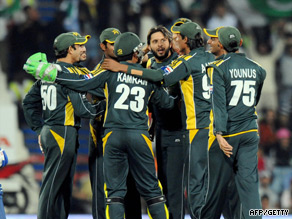
(CNN) -- Shoaib Malik scored a brisk century as Pakistan beat arch-rivals India by 54 runs in their Champions Trophy clash in South Africa on Saturday.

Shahid Afridi is congratulated after claiming a wicket in the Pakistan win.

Shahid Afridi is congratulated after claiming a wicket in the Pakistan win.

Man-of-the-match Malik blasted 128 for his seventh hundred in one-day internationals for Pakistan as they ran up an impressive 302-9 at Centurion Park.

India were up with the run rate but lost wickets at regular intervals to fall to 248 in reply.

Recalled veteran Rahul Dravid battled to 76, but his run out after a mix-up with Harbahjan Singh signaled the end of his side's chances.

Gautam Gambhir made 57 and Suresh Raina 46, but Pakistan's bowlers hit back at regular intervals.

Pakistan have now one both their matches in the four-team group, while Australia beat the West Indies by 50 runs in their earlier game at the Wanderers in Johannesburg earlier on Saturday.

India and the West Indies have yet to open their account with the top two teams going through to the semifinals after the group round-robin.

Lower order batsman Mitchell Johnson blasted 73 not out as Australia totaled 275 in their 50 overs. Captain Ricky Ponting made 79.

An understrength West Indies side were always struggling despite half centuries from Travis Dowlin and Andre Fletcher.

Pakistan accounted for the West Indies in their opening match and owed their big total to a stand of 206 between Malik and Mohammad Yousuf (87) - a record for the fourth wicket against India in one-day internationals.

India were up against it from the start as star batter Sachin Tendulkar fell in the fifth over to 17-year-old paceman Mohammad Aamer.

Gambhir responded with a string of boundaries, but he was run out following a mix-up with Dravid.

Raina also batted superbly with two sixes and five fours, but he was trapped leg-before wicket to Saeed Ajmal, who with fellow spinner Shahid Afridi exacted a stranglehold on the Indian battling line-up in excellent spells


Read more »»

Hurray: Pakistan win against India

.
0 comments

Shoaib Malik hammered a robust century to help Pakistan post a challenging 302-9 against India in a Champions Trophy match here on Saturday.

cricket_pak_09Malik made 128 for his seventh hundred in one-dayers as Pakistan recovered from 65-3 to set a stiff target for India in the day-night match, the first between the two teams in more than a year.

He received valuable support from veteran Mohammad Yousuf, who made a brisk 88-ball 87 and together they added 206, Pakistan`s best stand against India for the fourth wicket in one-dayers.

Both dominated the Indian attack with a wide range of attacking shots on a good pitch, with Malik completing his century in the 43rd over when he cut off-spinner Harbhajan Singh for a four.

The Malik-Yousuf onslaught saw Pakistan plunder 85 in the last 10 overs, much to the delight of fans.

Yousuf fell playing shots in the 46th over, bowled by left-arm seamer Ashish Nehra, but not before he had put his team in a strong position having cracked seven fours.

Malik was out in the penultimate over after smashing 16 fours in his 126-ball knock. Nehra was the most successful bowler with 4-55, but hardly received support from the other end.

Pakistan began aggressively after electing to bat as openers Imran Nazir and Kamran Akmal helped their team race to 50 in less than nine overs.

Nazir went for shots early in his innings, hitting four boundaries in his 17-ball 20 before top-edging a pull off Nehra to be caught by Harbhajan at mid-on.

Nehra struck again when he bowled Akmal for 19, but Malik continued to gather runs comfortably. None of the Indian bowlers could pressure on Malik and Yousuf.

Pakistan looked in trouble when skipper Younus Khan was caught behind off left-arm paceman Rudra Pratap Singh after contributing 20.

India then had to wait for more than 31 overs for their next success as Malik and Yousuf applied themsleves remarkably well to put their team in a comfortable position.

Meanwhile, Hundreds of thousands of people have come out on the streets all across Pakistan cities including Karachi, Hyderabad, and Lahore to celebrate Pakistan's victory against India by 54 runs in an ODI of ICC Champions Trophy at Centurion park on Saturday night, Geo news reported.

With this win Pakistan have also qualified for the semi final race by beating West Indies and now India in two consecutive matches of their group.

People in jubilation are dancing on drums doing Bhangra (traditional dance) and chanting slogans in spirit of victory.

Young boys are riding motorcycles and doing wheelies on main roads in Karachi, Lahore and Hyderabad

Read more »»

Kerry-Lugar bill insults Pakistan

.
0 comments

By Tahir Niaz (Daily Times)

ISLAMABAD: Asking the government to explain how it has accepted the language of the Kerry-Lugar bill, Pakistan Muslim League-Quaid (PML-Q) legislator Marvi Memon has said it is insulting to Pakistan.

In a statement issued on Sunday, she said that asking Pakistan to "cease support – including by any elements within the military or intelligence agencies – to extremist and terrorist groups" in the text of the Kerry-Lugar bill was insulting and sent a wrong message to the world. She said it had weakened Pakistan's position on the international front. Marvi said the issue of nuclear monitoring was unacceptable to any patriotic Pakistani. The Kerry-Lugar bill mandated Pakistan to provide the US "relevant information from or direct access to Pakistani nationals associated with such networks", she said, adding that it clearly allowed the US access to Dr AQ Khan and others, which was unacceptable as state policy. She said the guarantee that terrorism emanating from India and Afghanistan, which destabilises Pakistan, should be controlled was missing in the bill, which made it (the bill) one-sided. She asked the government to explain whether the aid provided through the Kerry-Lugar legislation was only for civilian projects or whether it also included police reforms, equipment and training.

Read more »»